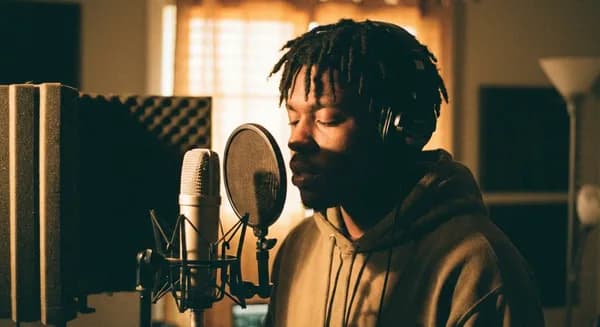
How to Get Drake-Style Vocals: Vocal Chain Breakdown
VP
VocalPresets Team
7 min read
You know the Drake vocal sound when you hear it. It's warm, present, intimate -- like he's talking directly to you. And every time you listen back to your own recordings, they sound flat, thin, or just off compared to what you hear on the playlist.
It's not your voice. It's the chain. And it's not as complicated as you think.
Here's how to get YOUR vocals hitting with that OVO quality -- whether you're going for the early Thank Me Later vibe or the modern Certified Lover Boy sound. If you are new to building vocal chains, start with our guide on vocal chain order to understand why each plugin goes where.
Before You Touch a Single Plugin
A lot of what makes Drake's vocals work starts before the chain. If your raw recording sounds bad, no amount of processing saves it.
Before you open a plugin, clean up your vocal if there's background noise or room reverb from your untreated bedroom. A noise gate or noise reduction plugin as the first insert handles most bedroom recording issues. Getting the raw file clean is step zero.
EQ -- Getting That OVO Tone From Your Mic
Your mic doesn't naturally produce the Drake sound. That's fine. EQ gets you there:
- High-pass at 80-100 Hz (clean the low end -- your room is adding junk down there)
- Small cut around 200-300 Hz (remove the muddiness that every bedroom recording has)
- Gentle boost around 1-2 kHz (add clarity so every word cuts through)
- Air boost at 10-16 kHz (that shimmer that makes your vocal sound expensive)
The key is gentle. You're nudging, not carving. Your voice should sound natural but polished -- not obviously processed.
Compression -- Making Every Word Hit
Drake's delivery is conversational. He goes from soft spoken to projected, and the compression keeps it all sitting at the same level. This is what you need for YOUR recordings:
- Attack: 10-15ms
- Release: auto or ~80ms
- Ratio: 3:1 to 4:1
- Gain reduction: 4-6 dB average
Budget picks: TDR Kotelnikov (free) or Analog Obsession's BUSTERse (free). Both punch way above their price tag.
Free
Big Drip

Vocal Labs
FreeThe Big Drip preset nails this vibe -- warm, intimate compression that makes your voice sound like it belongs on a hip-hop or pop record. Load it and tweak from there instead of building from scratch.
The Saturation Layer -- Your Secret Weapon
This is what makes a bedroom recording sound like a studio session. A gentle tape saturation plugin adds harmonic richness that your mic isn't capturing on its own. Run it as a parallel track -- 20-30% wet is enough to add texture without making it sound obviously processed.
Free options: Softube Saturation Knob, Analog Obsession TAPE, or Caelum Audio Tape Cassette. For more plugin recommendations, see our guide on best vocal chain plugins for bedroom producers.
Hazy
Vocal Labs
$14.99Hazy has that built-in textured warmth if you want the shortcut.
Reverb -- Room Presence, Not a Cave
This is where most bedroom artists overdo it. Drake's vocals don't swim in reverb -- they have room presence. The difference matters.
Use a room or plate reverb, not a hall. Pre-delay of 15-20ms, decay under 1 second, and keep the wet signal low (15-25%). You want the sense that there's space around your voice -- not that you recorded in a bathroom.
Free reverb: Valhalla Supermassive has a plate mode that works beautifully here. OrilRiver is another solid free option.
Delay -- Width Without the Wash
A quarter-note ping-pong delay on your ad-libs gives that spacious, layered feel without cluttering the lead. Low feedback (1-2 repeats), stereo spread. It widens your vocal mix and makes the whole recording feel bigger.
Keep it subtle on the lead. Go louder on ad-libs and doubles.
Stack Your Vocals Like a Record
Drake layers vocals constantly -- and this is where your recordings go from one-dimensional to professional. Record your main vocal, a subtle octave double, and ad-libs processed slightly differently. Pan the stack wider than the lead, with more reverb and delay. Your lead sits center and forward, the stack sits behind and wide.

Stargaze
Vocal Labs
$14.99Stargaze works well for your stacked/doubled vocal layers -- that shimmery trap R&B quality that fills out the sides.
Song-by-Song Breakdown
The Drake vocal chain is not one-size-fits-all. Here is how the processing shifts across different eras and tracks.
On Hotline Bling, the vocal is warm and dry with minimal reverb. The compression is gentle, the EQ has a prominent low-mid warmth, and the saturation is barely there. This is Drake at his most stripped-back. If your vocal sounds good raw, sometimes less processing is the move.
On God's Plan, the vocal has more energy and presence. The compression is tighter, the EQ pushes harder in the 2-4kHz presence range, and there is a noticeable plate reverb adding space. The delay is more active on the hook.
On Laugh Now Cry Later, the vocal is punchy and forward. Double-tracked vocals on the hook with tight compression and a brighter EQ curve than usual. The saturation is slightly more aggressive.
On Rich Flex, the vocal is confident and minimal. Very dry, very present, with the compression doing most of the work to keep the conversational delivery consistent. Minimal effects -- the vocal chain is almost invisible.
On Massive from Honestly, Nevermind, the processing shifts entirely. The vocal is run through a more electronic chain with filtered reverb and rhythmic delay. This shows the versatility of knowing your fundamentals.
Budget Alternative Chain (All Free Plugins)
Build the Drake sound without spending a dollar:
- TDR Kotelnikov -- transparent compression at 3:1 ratio, 4-6dB gain reduction
- TDR Nova -- dynamic EQ for surgical cuts and gentle boosts
- Analog Obsession TAPE -- subtle tape saturation at 15% drive, 25% mix
- Softube Saturation Knob -- secondary harmonic richness, very subtle
- Valhalla Supermassive -- plate reverb mode, 0.8 second decay, 20% wet
- Voxengo Tempo Delay (free) -- quarter-note ping-pong delay, low feedback
This free chain gets you the warm, intimate Drake sound. The paid equivalents offer more control, but the free stack delivers the character.
Recording Tips for the Drake Sound
Mic distance matters. Get close -- 4-6 inches -- but slightly off-axis to reduce plosives and sibilance. Drake's vocal is intimate and close-sounding. That proximity is part of the character.
Your room treatment has an outsized impact on this style because the vocal is so dry. Any room reflections from your bedroom walls will be audible and fight against the short, controlled reverb. Hang blankets, use a reflection filter, or record in a closet.
Perform like you are talking to one person. Drake's delivery is conversational, not projected. If you are belting into the mic, the compression has to work too hard and the intimacy disappears. Keep your volume moderate and let the chain bring the level up.
If you are working in FL Studio, set up your reverb and delay as separate mixer channels with sends rather than insert effects for independent mix control.
How Drake Compares to Similar Chains
The Drake chain shares warmth and saturation DNA with the Travis Scott vocal chain, but Travis pushes the reverb and Auto-Tune much further. Drake's chain is about intimacy and proximity. Travis is about atmosphere.
Compared to the Lil Baby vocal chain, Drake uses slightly more saturation and a touch more reverb. Lil Baby's chain is the driest and most minimal on this list.
The Playboi Carti vocal chain and Yeat vocal chain are on the opposite end of the processing spectrum. Where Drake preserves the natural voice, Carti and Yeat destroy and rebuild it.
For the technical deep-dive with exact plugin settings for each step, see our dedicated Drake vocal chain breakdown.
Quick Reference Chain Order
- Noise reduction (if needed -- and in a bedroom, it's probably needed)
- EQ (surgical cuts first, gentle boosts)
- Compression (VCA-style, 3:1-4:1)
- Saturation (parallel, low wet%)
- EQ again (broad, gentle tone shaping)
- Reverb (room/plate, subtle)
- Delay (quarter-note, ping-pong)
Frequently Asked Questions
Does Drake use Auto-Tune? On some tracks, yes -- particularly melodic hooks and singing sections. But the signature Drake sound on verses is clean with no pitch correction, or very subtle correction you cannot hear. If you want to add pitch correction, use a retune speed of 30-50ms so it sounds natural.
What microphone does Drake use? Drake has been tracked on high-end mics like the Sony C800G and Neumann U47. You do not need these. A Rode NT1, Audio-Technica AT2020, or even an SM58 dynamic mic with this chain gets you in the right ballpark. The processing compensates for microphone differences more than most people realize.
How do I get the Drake sound on Ableton versus FL Studio? The plugin settings are identical regardless of your DAW. The only difference is workflow -- how you set up sends for reverb and delay. We have guides for both: our Ableton install guide and FL Studio presets page cover DAW-specific setup.
My vocal still sounds thin even with these settings. What am I missing? Two common causes: your room is adding cancellations at certain frequencies (fix with treatment or a reflection filter), or your mic's proximity effect is not being leveraged. Move closer to the mic. That low-mid warmth from proximity is a free EQ boost that makes the entire chain work better.
Get comfortable with this chain and YOUR vocals will have the foundation for most modern hip-hop and R&B sounds -- not just Drake specifically. The specifics change but the approach stays the same.
Ready to skip the setup? Browse our vocal presets for chains built for hip-hop and R&B artists, or start with our free vocal presets to hear the difference immediately.