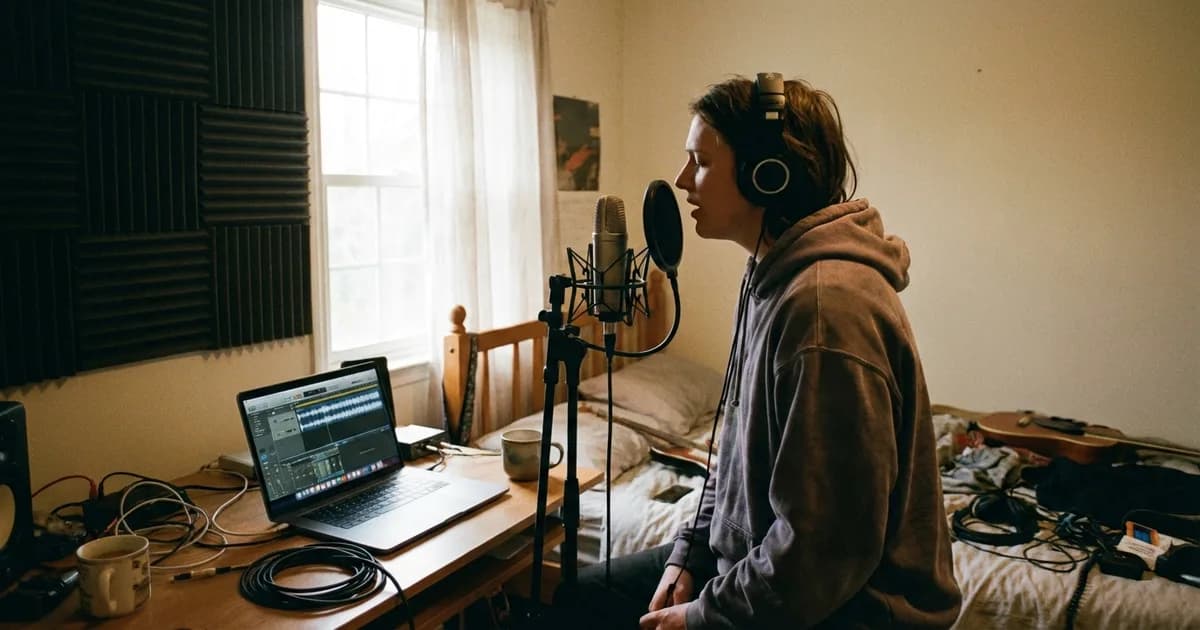
How to Sound Like a Major Label Artist Recording from Your Bedroom
VP
VocalPresets Team
5 min read
You know the feeling. You listen back to your recording and then you play a track from an artist you admire. Their vocal sounds massive, polished, like it was recorded somewhere expensive. Yours sounds thin, roomy, and obviously homemade. It is frustrating because you know you have the talent — the recording just does not do your performance justice.
Here is what most people will not tell you: the gap between your bedroom vocals and what you hear on streaming platforms is way smaller than it sounds. It is not about money or access. It is about a handful of specific techniques that professional recordings have in common — and all of them are things you can do at home.
Why Your Vocals Sound "Bedroom"
Before you fix it, understand what is causing it:
- Room reflections — your walls are bouncing sound back into the mic, adding a hollow, boxy quality that screams "recorded at home"
- Inconsistent levels — you are too far from the mic, or your gain is wrong, so the vocal sounds distant or clips
- Mic technique gaps — small things like singing off-axis, no pop filter, or too much proximity effect
- No processing chain — raw vocals always sound amateur next to processed ones. Always.
- The vocal sits on top of the beat instead of inside it — a mixing issue that processing solves
Major label vocals do not sound better because of a $10,000 microphone. They sound better because of controlled rooms, consistent technique, and a vocal chain that ties it all together. You can replicate all three.
Step 1: Kill the Room Sound ($50 or Less)
You do not need professional acoustic panels. You need to stop your walls from coloring your vocal:
- Hang a thick blanket behind you while recording. The sound bouncing off the wall behind you is the single biggest problem in most bedroom recordings.
- Record in a closet full of clothes. Seriously. Clothes absorb sound. A walk-in closet is a better vocal booth than most home "studios."
- Use a reflection filter behind the mic ($30-50). Not a substitute for treatment, but a meaningful improvement.
- Get away from your desk. If your monitor screen and hard desk are right in front of the mic, those reflections are going straight into your recording.
The goal is not dead silence. You just need 60-70% less room sound. That is the difference between "obviously a bedroom" and "could be anywhere."
Step 2: Nail Your Mic Technique
These small adjustments make a bigger difference than any plugin:
Distance: 6-8 inches from the mic. Closer than that and your voice booms from proximity effect. Further than that and you get more room than voice.
Angle: Sing or rap slightly off-axis — about 10-15 degrees to the side of the mic rather than dead center. This naturally reduces plosives and sibilance without any processing.
Pop filter: Use one. A $5 pop filter prevents problems that are genuinely impossible to fix later. No exceptions.
Gain staging: Set your input so the loudest part of your performance peaks at -6 to -10 dB in your DAW. Never clip. Digital clipping sounds horrible and it is permanent.
Step 3: Record Clean Takes
The raw recordings on major label sessions have one thing in common: they are clean. That means:
- No background noise. Turn off the AC, close the window, shut the door. Yes, every time.
- Consistent distance from the mic. Do not sway or lean while recording.
- Multiple takes. Record at least 3-5 takes of every important section, then comp (piece together the best moments). This is standard practice — not a workaround. Your favorite artists comp their vocals.
- Record dry. No effects on the input. Clean, unprocessed signal. All the processing happens after.
A clean raw vocal gives you options. A noisy one limits everything your chain can do. If background hum, hiss, or room noise slipped into a take you cannot re-record, run it through our AI vocal cleanup tool before you start processing — it strips noise without touching the voice.
Step 4: The Vocal Chain That Closes the Gap
This is where bedroom recordings become competitive. The right vocal chain is the difference between "demo" and "release." If you want a chain built around your specific voice and genre, our vocal chain recipe generator spits out starting settings tailored to what you are recording:
1. High-pass filter at 80-100Hz — instantly removes the room rumble that makes your vocal sound muddy and amateur.
2. Subtractive EQ — cut the frequencies that sound bad:
- Room boominess: cut 2-3dB around 200-300Hz
- Nasal/boxy tone: cut 2-3dB around 400-600Hz
- Harshness: cut 1-2dB around 2-3kHz if needed
3. Compression — make your vocal sit evenly:
- Ratio: 3:1 to 4:1
- Attack: 5-10ms
- Release: auto or medium
- Gain reduction: 4-6dB on the loudest parts
4. Additive EQ — boost what sounds good:
- Presence: +2-3dB around 3-5kHz (this is what makes your voice cut through the beat)
- Air: +1-2dB shelf at 12kHz (this is the "expensive" frequency range)
5. Saturation — subtle tape or tube saturation adds warmth and makes digital recordings sound analog. Keep it barely noticeable.
6. Reverb on a send — short plate or room, 1-1.5 second decay, mixed low. This adds "space" without making it sound like you recorded in a bathroom.
7. Delay on a send — quarter note or dotted eighth, low feedback, mixed subtly. Adds depth and dimension.
Step 5: Reference Against the Artists You Want to Sound Like
Load a reference track into your DAW. A song by an artist whose vocal sound you are trying to match. A/B your vocal against theirs:
- Match the volume first so you are comparing fairly
- Compare frequency balance — does yours sound darker? Brighter? Adjust EQ
- Compare dynamics — does theirs sound more consistent? Adjust compression
- Compare space — more or less reverb? Adjust
This one habit will improve your sound faster than buying any plugin. You are training your ears to hear the specific differences and close them one by one.
The Honest Truth
There is no secret plugin. No hidden technique that major label artists have access to and you do not. The formula is:
- Reduce your room sound
- Use proper mic technique
- Record clean takes and comp
- Process through a solid vocal chain
- Reference against pro mixes
That is the entire gap. Everything else is refinement. If you want to test the chain approach without spending anything, grab a few free vocal presets and hear the difference on your own recording before you commit to anything.
You can realistically get 90-95% of a major label vocal sound from your bedroom. The remaining 5% is the difference between a world-class recording studio and your room — and honestly, most listeners on Spotify will not hear that difference.
Skip Straight to Professional Sound
If building a vocal chain from scratch is not where you want to spend your time right now, vocal preset packs give you a complete processing chain — correct plugin order, professional settings, everything balanced — in one click. Load it, adjust to your voice, and focus on making music.